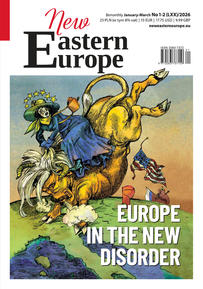




Twenty years ago, the European Union experienced its largest enlargement ever, the so-called Big Bang, with the addition of 10 new member states. This enlargement included many of the countries in our region – Poland, Hungary, Czechia, Slovakia, Slovenia and the three Baltic states of Estonia, Latvia and Lithuania. This momentous occasion marked the culmination of hard work by the EU and the post-socialist united Europe (and more members on the way), it seems as that Euro-optimism had reached its pinnacle moment.
And since 2004, the new member states have certainly made some remarkable achievements. The GDP per capita in purchasing power parity of the new states grew from 59 per cent of the EU average in 2004 to 81 per cent in 2022. The income gap between the older and newer states has also narrowed over the last 20 years. Some countries’ living standards, such as Czechia or Slovenia, have even surpassed those of older EU members.
Yet, at the same time, these past two decades were not without challenges. Issues related to democratic backsliding, the rule of law and corruption have tainted the legacy of the enlargement. Voices in many western European capitals began questioning whether the enlargement itself was too soon. After a series of crises hit the EU, which began with the 2008 financial crisis, a rise in Europscepticism began to counter the accomplishments of the previous generation of Euro-optimists and putting a major damper on any future enlargements.
Thus, the question today is: how united is Europe after these past 20 years? Certainly, the east-west divide remains a point of contention. However, other issues have also emerged, such as the rise of far-right populism and the debate over support for Ukraine. These phenomena can be found throughout Europe, and especially worth considering following the elections to the European parliament this June. As geopolitics once again becomes a key factor in European decision-making, we can only hope that unity prevails over division. Otherwise, the legacy of the EU Big Bang will be lost to the history books.
New Eastern Europe is a new bi-monthly magazine dedicated to Central and Eastern European affairs. The magazine is the sister edition of the Polish version Nowa Europa Wschodnia, which has been on the Polish market since 2008. Countries in particular focus in New Eastern Europe include Russia, Ukraine, Belarus, Moldova, as well the Caucasus region - Georgia, Armenia, Azerbaijan, Chechnya, etc.
Articles in New Eastern Europe focus on a wide range of social, political and cultural issues facing this region. The journal includes original opinion and analytical texts; historical accounts; reports from correspondents in the countries with full colour photos; and reviews of books, music and film about and emerging from Eastern Europe.
And since 2004, the new member states have certainly made some remarkable achievements. The GDP per capita in purchasing power parity of the new states grew from 59 per cent of the EU average in 2004 to 81 per cent in 2022. The income gap between the older and newer states has also narrowed over the last 20 years. Some countries’ living standards, such as Czechia or Slovenia, have even surpassed those of older EU members.
Yet, at the same time, these past two decades were not without challenges. Issues related to democratic backsliding, the rule of law and corruption have tainted the legacy of the enlargement. Voices in many western European capitals began questioning whether the enlargement itself was too soon. After a series of crises hit the EU, which began with the 2008 financial crisis, a rise in Europscepticism began to counter the accomplishments of the previous generation of Euro-optimists and putting a major damper on any future enlargements.
Thus, the question today is: how united is Europe after these past 20 years? Certainly, the east-west divide remains a point of contention. However, other issues have also emerged, such as the rise of far-right populism and the debate over support for Ukraine. These phenomena can be found throughout Europe, and especially worth considering following the elections to the European parliament this June. As geopolitics once again becomes a key factor in European decision-making, we can only hope that unity prevails over division. Otherwise, the legacy of the EU Big Bang will be lost to the history books.
New Eastern Europe is a new bi-monthly magazine dedicated to Central and Eastern European affairs. The magazine is the sister edition of the Polish version Nowa Europa Wschodnia, which has been on the Polish market since 2008. Countries in particular focus in New Eastern Europe include Russia, Ukraine, Belarus, Moldova, as well the Caucasus region - Georgia, Armenia, Azerbaijan, Chechnya, etc.
Articles in New Eastern Europe focus on a wide range of social, political and cultural issues facing this region. The journal includes original opinion and analytical texts; historical accounts; reports from correspondents in the countries with full colour photos; and reviews of books, music and film about and emerging from Eastern Europe.